Mogadishu, Somalia | December 12, 2025
The Somali Women Journalists Organization (SWJO) wishes to formally clarify and place on record its position regarding recent engagement initiated by the National Independence Electoral and Boundaries Commission of Somalia (NIEBC) involving members of the media.
In recent days, SWJO received repeated official requests from the National Election Committee to attend what was presented as a meeting for Somali media practitioners. In good faith, and in recognition of the importance of credible electoral processes and responsible journalism, SWJO agreed to participate. Our Secretary General, Ms. Leylo Osman, attended the event on behalf of the organization.
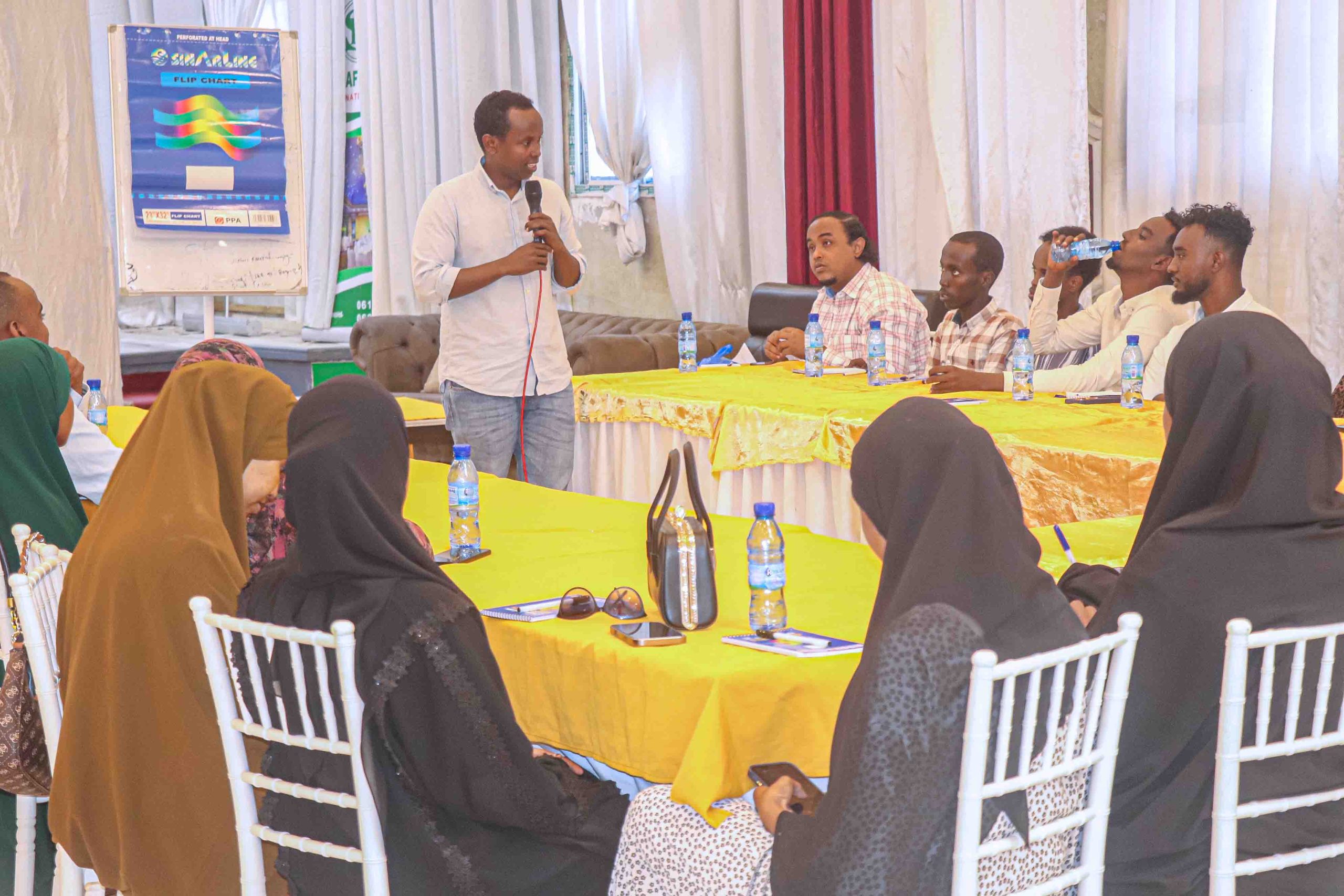
Upon arrival, it became clear that the gathering was not a meeting, but a structured workshop, the nature and purpose of which had not been disclosed in advance. SWJO initially raised concerns about this mischaracterization. However, given the presence of journalists and the sensitivity of the electoral context, our representative remained in the room to observe proceedings.
At the conclusion of the workshop, journalists were informed that they would be issued official election reporting badges, which would grant access to polling stations and electoral processes. Journalists were then instructed to sign documents as a prerequisite for receiving these badges.
During this process, Ms. Osman was unexpectedly called to the stage and asked to sign a document, alongside another individual. The Chair of the NIEBC subsequently added his signature, after which the event was abruptly concluded.
SWJO immediately sought clarification as to:
- Why only select individuals were asked to sign;
- Why the document was not shared in advance;
- Whether journalists had been given the opportunity to read or consent to its contents; and
- When and under what conditions the promised press badges would be issued.
Following prolonged engagement and direct communication with the NIEBC, SWJO was informed that the document signed was a 14-page Code of Conduct for Journalists During the Election Period—a document that had never been shared with, consulted on, or reviewed by SWJO or the wider journalistic community prior to the event.
Upon obtaining and reviewing the document, SWJO is deeply alarmed by its contents. Several provisions impose severe restrictions on journalistic work, undermine editorial independence, and include language that may expose journalists to intimidation, sanction, or punitive action. Such measures are incompatible with constitutional guarantees of freedom of expression and international standards on media freedom.
SWJO considers the manner in which this document was introduced, signed, and presented as unacceptable and misleading.
Following this incident, SWJO held a direct meeting with the Chair of the NIEBC to formally object. We clearly stated that:
- SWJO does not consent to the use of its name or institutional credibility in relation to this document;
- The signature obtained under these circumstances cannot be considered informed or legitimate;
- SWJO was not a party to the development, endorsement, or approval of this Code of Conduct.
We hereby publicly affirm to journalists, partners, donors, and the international community that SWJO has never been part of this process, and does not endorse the Code of Conduct in its current form.
This incident must also be understood within a broader and troubling context. Somali journalists—particularly women journalists—continue to face persistent threats, harassment, arbitrary arrest, confiscation of equipment, and intimidation while carrying out their professional duties. Any election-related framework that further constrains media freedom without consultation only exacerbates these risks.
SWJO calls on the National Election Committee to:
- Immediately suspend the use of this Code of Conduct;
- Engage in transparent, inclusive, and meaningful consultation with journalist unions, media organizations, and civil society;
- Ensure that any election-related media guidelines fully respect freedom of expression, due process, and international human rights standards.
SWJO remains committed to supporting ethical, professional, and responsible journalism during electoral processes—but this must never come at the expense of journalists’ rights, safety, or independence.
Ends